

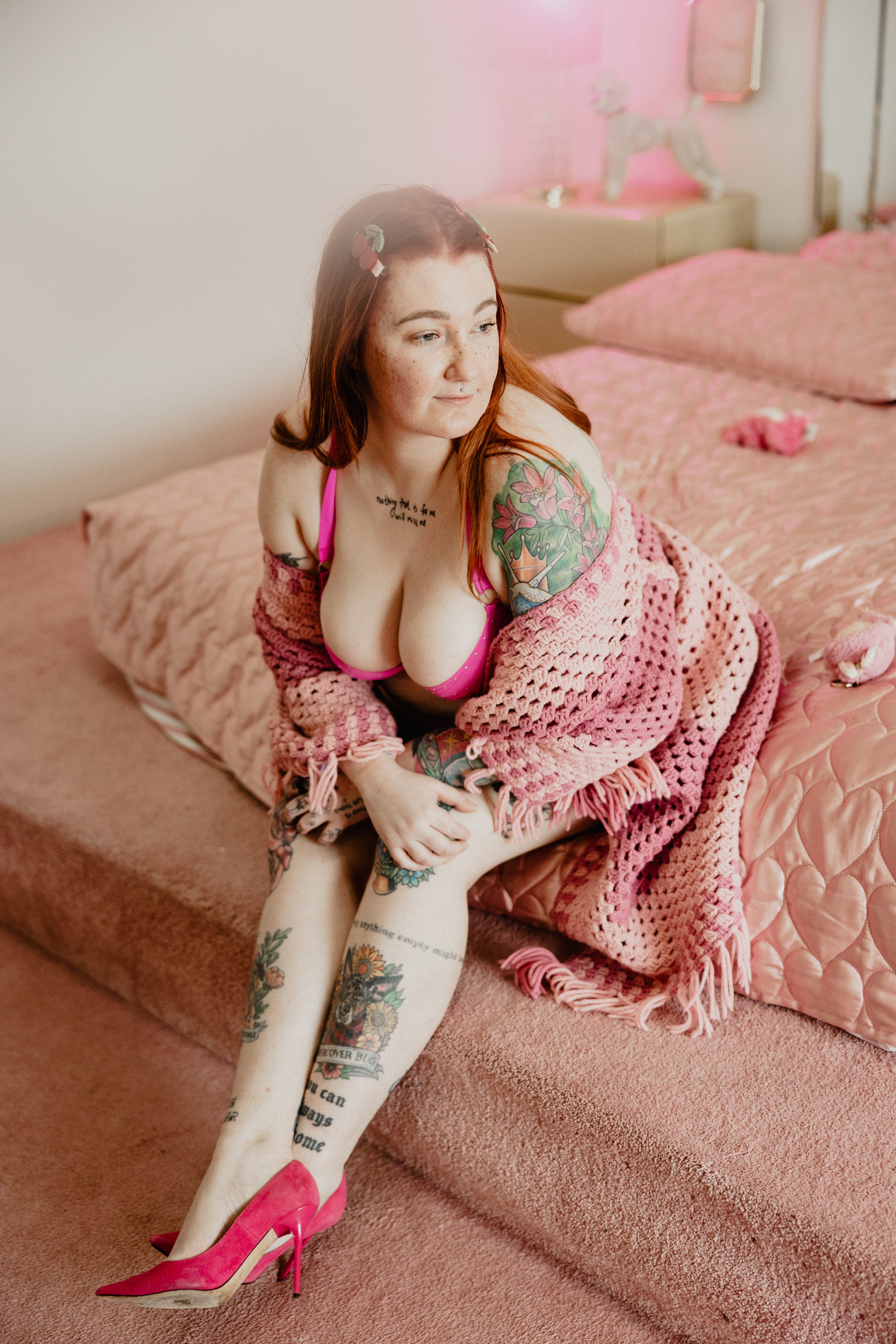
I didn’t think that I would have the strength to do a boudoir photo shoot before my double mastectomy. It was too fast. My appointment with my surgeon was 24 hours after I was diagnosed, and my surgery was a week later. I hadn’t processed my grief yet. I still haven’t processed everything.
I just really didn’t think that I’d be in a place to strip down to my lingerie and take sexy photographs. Friends, however, had different plans for me, knowing that somewhere in the future, this relic of part of myself would matter. They found a photographer and a venue an hour from my house and one of my friends took me to get a new set of lingerie.
When the sales associate asked what it was for, I told her, “I am losing my breasts in less than a week.” She teared up and nodded. You don’t have to tell people you have cancer for them to know. At the end of the visit, she told me that one of her colleagues is really good with prosthetics. She, like many strangers who met me over those weeks, hugged me goodbye.
I took photographs in a dingy midcentury modern house with cobwebs in the corners and semen stains not visible to the naked eye but definitely there. You could smell them, feel them.
In most of the photographs I look sad. It’s because I was sad.
They feel like an honest portrait of my life. One day, far from now, I’ll take another set with a fully flat chest covered in tattoos, and I’ll place it beside this set of photographs. I saved the lingerie I wore exactly one time to put in a shadow box in my bedroom, a testament to the body I once had, a testament to the body I once loved. I’m glad I have those photographs. They are a beautiful portrait of a really painful moment in time.
It took me a long time to love the body in those photos, but in the end, I did.
When I woke up from surgery, a nurse had tucked a stuffed animal I took into surgery underneath a sheet on top of my flat chest, so I woke up with it in my arms. For a moment, it felt like the same size as a breast, and I wondered if I was dreaming, until I felt its soft fur. I moved it away from me and felt the flatness of my body. I found myself grieving not just the loss of my breasts, but the loss of all the time it took for me to love them.
The first time I saw my body after my double mastectomy, I wasn’t expecting to.
I went into a post-operative appointment and they undressed my wounds to see the source of hives that ran down my skin. When I looked down, the tears came instantly. I wasn’t ready. A friend was in the room with me and she cried, too, dabbing her eyes with the tissues we couldn’t keep out of our hands in those early days. I caught her eye as the nurses dressed my wounds and I could see that she was processing my grief. She was the same friend who came with me to my lingerie fitting, one of the last people to see my body. It’s a strange fact of being single at this time. My closest friends and a photographer were the last people to see my breasts, not someone I might love for the rest of my life.
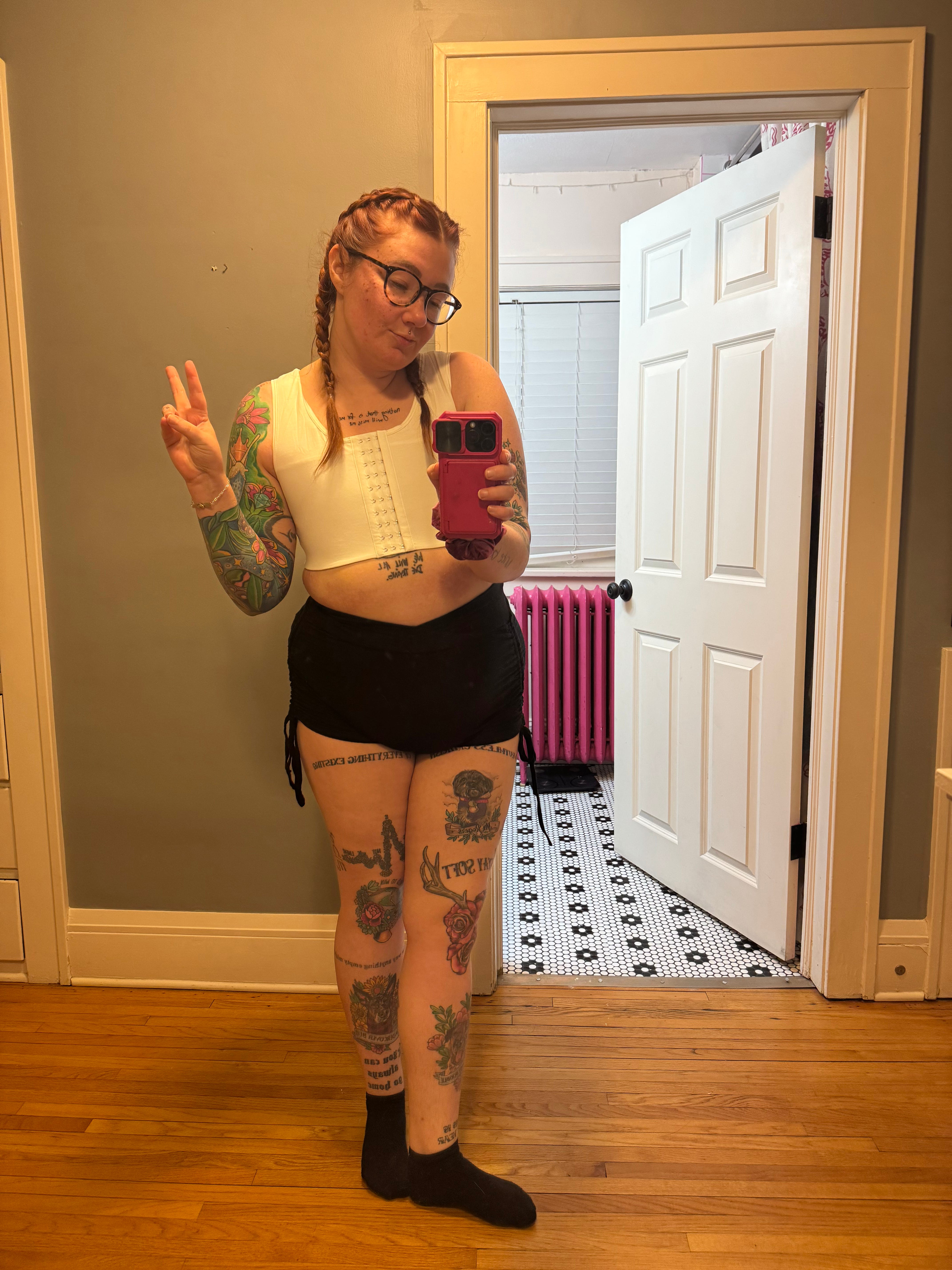
That night, I took off the binder they put on me and stared at myself in the mirror. I was a foreigner to myself. I called it gender de-affirming.
But it was less about me and more about the way I knew that men would see me now. I didn’t even have to guess at what they thought.
I knew. They told me.
Men sent me messages that read less like condolences and more like funerals.
Things like, “I wish we could have when we had the chance,” which meant sex, as if they assumed I would have, when the reason we didn’t is that I wouldn’t have. This same man followed that up with, and this is a direct quote, including the typo, “But they’re not taking you 🍑 too though right. 👀” As if the breasts are fine, but losing both is a bridge too far. I didn’t tell this man that I likely will lose my ass, not by choice, but because eating on chemo is a hard task–and because I already have lost a significant amount of weight due to the stress of this impossible moment in my life.
One man I once really loved told me that he was glad he got to see “them,” as if my breasts are detached from me, and not a part of me. Another sent me a photo of champagne being poured in the snow with, “Pouring one out for your really good tits.” Or men sent me photographs I sent of my breasts with, “You were one for the ages,” or, “I just want you to know how hot you were.”
These messages were all past tense, as if the loss of a single body part was equivalent to death. My response to most of them was in response to that concept: “I am not dead.”
It didn’t take me all that long to process that to many of these men, it was a death of a kind. It was the end of their romantic attraction to me.
The loss of my breasts was equivalent to the end of their desire, and the end of a man’s desire is the end of part of your life to him.
Men’s grief for my own body was apparent. Most of them, when telling me these things, did not acknowledge that they were happy my cancer was caught so early or that I had a good chance of saving my life.
Most of them didn’t seem to be thinking about me at all. Because for them, that wasn’t the point.
I know, in many ways, this is about their shortcomings, and not about mine. Except–when you are 34 and single with a mandate from your doctor to enter menopause as soon as you are through chemo, there is no way you cannot take this message in like an omen for loves to come: fewer and further between. Because why? Because now my chest is a marker of all the things I am willing to do to try to save my life. Commitment to saving yourself is noble, but to many men, it’s less beautiful than my body used to be.
Women, and men who love me platonically, tell me this won’t be the case for every man, but I think if they sat with their knowledge of most men, they would see how narrow the path is for love on the other side of a choice like this one. As they started seeing the messages I received, most of them were shocked. I wasn’t.
What was the other choice instead of going flat, anyway? It was reconstruction, which comes with more surgeries, lower satisfaction rates, a surgery date further down the line so the cancer can grow larger inside of me, a high chance of complications, and then delayed chemo while they try to fix mounds on my chest that won’t ever look like mine. It’s a choice with significantly more pain, that most women I talked to described as howling.
The other choice was creating fake breasts for men and slowing down the narrow sliver of time in which I might be able to beat this.
Women choose that path all the time.
Most women I know who chose this have their own kinds of grief and some kind of chronic pain. Most of the women I know who did reconstruction told me that if they could go back in time, they would have made a different choice. Instead of listening to men, I listened to them. Knowing the facts of their pain or their near constant surgeries, it wasn’t worth it, even though it would have made finding a life partner a little bit easier. Waiting longer for surgery and chemo, or being in lifelong pain, just wasn’t a trade I was willing to make–and the fact that so many women make it is a damning indictment of men, not women.
I didn’t think about men when I made the choice to go flat and not spare any skin, not even a nipple. I was just trying to save my fucking life.
When I look in the mirror, I have to admit that I don’t hate my body in the way I thought I would.
I grieve what it represents, but the loss of my favorite physical part of me is a small price to pay for a chance at life. The grief of the loss of my breasts is tremendous, not because I particularly miss them. I actually kind of enjoy not having to wear a bra, and I like the way my flat chest looks in sweaters, though less so in the deep V tank tops that have become a staple in my wardrobe. I know that swimming topless at cabins will feel like freedom. A few dresses I used to have to squeeze my breasts into are easy to put on now, and the ones that have gaping are easily fixed by a tailor.
I have no doubt that once I am fully tattooed, I will find my body beautiful, the same way I found the one I used to live in beautiful. That was one of the only things my surgeon and I talked about when she marked me up: one single scar, built around tattoos. It doesn’t look like your average top surgery or double mastectomy scar. Those normally curve downward, or there are two scars like little half smiles. My scar curves upward, like a rainbow, or a frowny face, to keep two of my tattoos intact. The other way of building the scar, the normal way, would have left them cut in half.
This scar was built with my gaze in mind, no one else’s. When I look at photographs of other women who have lost their breasts, my scar looks nothing like theirs. It’s unique, shaped to my body.
It’s a beautiful act that my surgeon maintained all the tattoos I already have and built the scar around photographs of tattoos I wanted in the future. It’s something I don’t even know how to thank her for.
My grief isn’t about how it feels to look at myself in the mirror. It’s about what I know it means for me in romance. It means fewer options or being seen as less feminine, or men seeing me as less sexy.
Most of the grief about my body isn’t mine, but by proxy.
It’s so deep and so rampant that no fewer than 10 men said something to me about this as a thing they personally will miss, even though some of them never saw me naked and none of them ever would again, cancer or no cancer.
The loss of something they will never have again was enough to drive them towards sadness–what about the man I want to marry one day? Will it drive him towards sadness, too? Will he say the same thing to me that one man I was dating said to me when he found out? That he would have continued to date me if I had made another choice? That if I had just kept my breasts, he would have stuck around?
So many of my friends say things to me like, “Okay, well that’s not your husband,” not realizing that this actually is just how most men are. This isn’t a small subset of men. A flat chest without nipples on the body of a woman who isn’t skinny and who fought breast cancer, isn’t considered attractive–and that means my chances at love are lower, because desire comes before men will take any time in getting to know you.
Some of that you can’t control, but I want to push men to consider that some of it is about more than desire. It’s about how little they value the humanness of women.
I wish, instead of people making a judgment that these men who sent me messages are a particular set of not so good men, we sat and assessed how our constructs of gender have built this. It’s not just a particular set of not so good men, but how we teach men to value women, how we teach them to find women attractive, and how we reduce women to their bodies. I wish, instead of men assuming they would never act this way, personally, that they would process their connections to these constructs and start to untangle them individually inside of themselves.
I think most single men would–and do–act the way men acted towards me, but would be able to see these scars on the love of their life as something like courage. Because after men get beyond objectifying you, that’s when you become human.
A few married women said this to me. They said, “Don’t worry, my husband loves it.” But I think, again, there’s this missing piece here. I’m single. It’s not that I don’t think this is a beautiful fact for them. It’s just that for men to get to see it as courage, it often requires them to know you for a long time first. For me, it has already been presented as only an unthinkable loss, and not because it means I am going through the hardest year of my life, but simply and only because men won’t be able to enjoy my breasts anymore, personally.
This pain is a pain women feel at the hands of men and so reducing the pain isn’t just on me processing my feelings with other breast cancer survivors.
This is men’s work.
This expectation that it’s my problem and my grief to deal with isn’t something I’m taking on. I especially feel this way because some men have done this work, telling me that my value to them has nothing to do with my body before I even asked, or telling me that I look beautiful days after surgery when I definitely did not. These men aren’t the norm, though, they’re clear outliers–and most of them are queer, with dating preferences that don’t center traditionally feminine bodies but rather center compatibility. That’s a lifetime of work.
It’s also something a man directly said to me after he saw me after my surgery, that he felt “low chemistry, high compatibility.” Men will stand in front of a woman who they know is compatible with them and not spend any time untangling the sexist body image standards they have for women before writing that woman off.
Women in my life, however, do this work all of the time, spending hours in therapy getting over their aversion to receding hair lines or sloppy dress because we know that judging a man by these standards doesn’t value him as fully human—and because we know that things like height and weight preferences are patriarchal concepts that are our work to unravel. This work is uneven, with men telling me all the time that women won’t date them because they are under six feet tall or balding or because they wear basketball shorts out to fancy dinners, but then when I gently nudge them about dating a woman who isn’t a size four, the same rules do not apply.
It’s similar to how men have benefited significantly from feminist dating norms where now dates go dutch and split the household bills, but men still do significantly less of the household labor. It’s a question I ask on first dates with men who claim that they want a relationship not tied to gender norms: what are the parts of women’s work they have picked up? I have yet to have a man be able to answer that question. It’s telling.
Where feminism—and women—have benefited men, men can’t be bothered to put in the same amount of work for women.
I was tired of it before I lost my breasts and I’m even more tired of it now.
Women are often expected to carry the emotional labor for men on things like this–to educate them, to push them, to maybe just accept that their grief about the loss of our breasts is just how things are. I have my own shit to take care of, mostly saving my life, and “helping a man see me as an object of desire without breasts,” isn’t even at the very bottom of my to-do list.
Men’s grief betrays that deep down in many of them, my value is still tied to my body, and not the other beautiful parts of me.
Their grief betrays that, at the end of the day, they don’t see me as a full person, but as an object of their desire. Choosing not to center them in the hardest time of my life isn’t acceptable to them. To them, it is, in fact, damning. Because as a woman, you are supposed to center men on your worst days, too, even if you are centering saving your life over a man’s attraction to you.
But here’s the thing: while men are reducing me to my body to make a judgment about if I will, one day, make a good wife, I have found myself turning to their actions and their words to question what kind of husband they might be.
I will make a good wife, because bravery, grit, tenacity, and a commitment to undoing the internal patriarchal expectations of men that I was taught are qualities you want in someone you will love on your hardest days, and because the more trials you face in life, the easier the hard times in marriage become.
Wonderful writing and thoughts. Thank you for sharing and challenging me to think this morning. Sending you positive energy.
Ooof. That was a hard one. But still I thank you for speaking truth to men, And writing about it.